
-
 Technology Portfolio
Versigent draws on the most innovative and optimized technologies to create a full range of advanced power, signal and data distribution systems.
Technology Portfolio
Versigent draws on the most innovative and optimized technologies to create a full range of advanced power, signal and data distribution systems. -
Signal & Data
Signal and data network technologies connect key systems, handling everything from simple control signals to large data flows.
-
Power
Regardless of powertrain, today’s vehicles rely on extensive power distribution capabilities to function.
-
Working With Us
With Versigent, our customers get a partner that deeply understands their design and execution needs.
-
Design
Versigent has the boldness, creativity and versatility to design innovative and unexpected solutions for your most complex requirements
-
Execution
Versigent excels at manufacturing efficiency, automation and execution. It’s an integral part of everything we do.
-
About
Versigent is a global leader in intelligent electrical architectures, delivering solutions at speed with a legacy of innovation and expertise.
-
Senior Leadership
Versigent’s senior leadership team brings deep industry expertise and a focus on innovation to drive solutions at speed.
-
Investors
Visit Versigent’s Investor Relations Site.
-
Sustainability
We deliver solutions of the highest quality and reliability – designed, developed and manufactured responsibly – that transform society.
-
Technology Portfolio
Versigent draws on the most innovative and optimized technologies to create a full range of advanced power, signal and data distribution systems.
-
Signal & Data
Signal and data network technologies connect key systems, handling everything from simple control signals to large data flows.
-
Power
Regardless of powertrain, today’s vehicles rely on extensive power distribution capabilities to function.
-
Working With Us
With Versigent, our customers get a partner that deeply understands their design and execution needs.
-
Design
Versigent has the boldness, creativity and versatility to design innovative and unexpected solutions for your most complex requirements
-
Execution
Versigent excels at manufacturing efficiency, automation and execution. It’s an integral part of everything we do.
-
About
Versigent is a global leader in intelligent electrical architectures, delivering solutions at speed with a legacy of innovation and expertise.
-
Senior Leadership
Versigent’s senior leadership team brings deep industry expertise and a focus on innovation to drive solutions at speed.
-
Investors
Visit Versigent’s Investor Relations Site.
-
Sustainability
We deliver solutions of the highest quality and reliability – designed, developed and manufactured responsibly – that transform society.
Even without taking the transition from internal combustion engines to battery electric vehicles (BEVs) into account, the electrical power requirements of today’s vehicles have become daunting. Every device within a vehicle — from the air conditioner and seat heaters to the lighting and infotainment systems — requires power, and the wires supplying that power must have a large enough diameter to support the current.
The high number of devices and their corresponding wires creates substantial challenges in packaging and routing. As OEMs focus on improving fuel economy and EV range, the weight and cost of all those wires is coming under increased scrutiny.
One way to shrink the wire gauges and reduce weight and cost throughout is to move from a 12V electrical architecture to one based on 48V. But OEMs that move to 48V have to pay particular attention to several key design considerations to ensure the system’s safety and reliability.
ROOTS IN 12V
This is not the first inflection point in vehicle electrical architectures. The automotive industry faced similar challenges 70 years ago, albeit on a smaller scale. Before the 1950s, most cars used 6V batteries and electrical systems. Increases in both content and copper prices drove a revolution, and in the span of a decade, vehicles worldwide changed to 12V.
Because electrical power is governed by the equation P=V×I (power equals voltage times current), doubling the voltage means that a device can receive the same power with half the current. Current dictates wire diameters, in that thicker wires have less resistance and therefore are necessary to safely carry higher current. The converse is also true: A lower current can safely run over a thinner wire, so reducing the current enables the use of smaller wires, terminals and connectors — all of which reduces weight and material cost.
So increasing voltage is an important tool in the toolbox to address increasing content, packaging, weight and cost. Since the 1950s, the average amount of current flowing through 12V systems has increased more than 650 percent. It is clearly time for another architecture overhaul.
WHY 48V?
Now that 12V has become too limiting, many automotive OEMs have targeted 48V as the most logical step forward because it hits a sweet spot: Increasing voltage by a factor of four reduces current by a factor of four while staying well below the 60V limit of what is generally accepted as protection against shock hazard. By adopting 48V, designs can be protected for up to 60V in the case of an overvoltage.
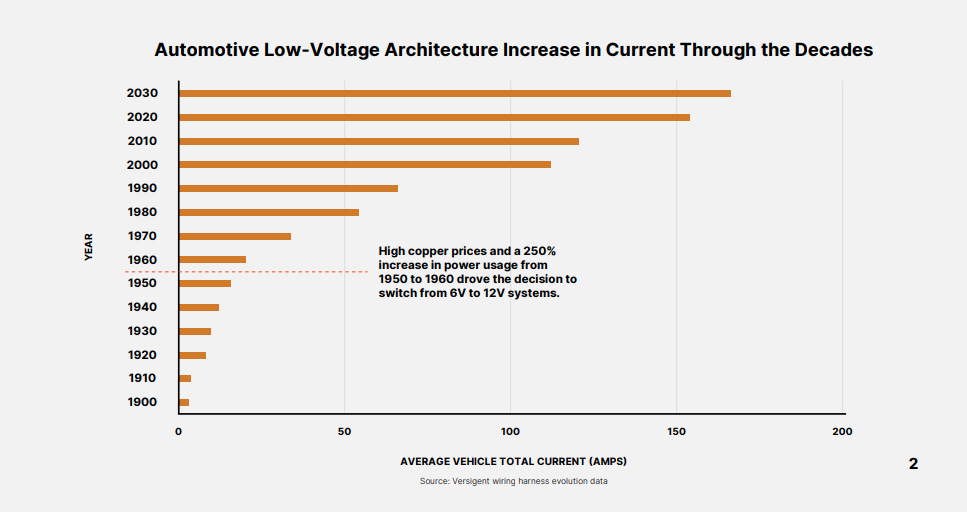
In addition to enabling significantly smaller terminals and wiring, the higher voltage is more power-efficient. Ohm’s law dictates that P=I2R (power equals the square of the current times resistance), so because the current in a 48V architecture is one-fourth the current in a 12V architecture, any power losses due to resistance in the power delivery system can theoretically be reduced by a factor of 16. Of course, resistance will increase as wire size is reduced, so the actual losses will depend on system optimization. Still, as current is reduced, there will also be less of a voltage drop across a wire when driving a load.
Several devices, such as starter motors, will also benefit from the higher operating voltage. They will require less copper and provide more torque while potentially having a smaller package size.
DESIGN CONSIDERATIONS
If the transition from 12V to 48V offers all of these advantages, why hasn’t the automotive industry already switched? It has been considered in the past, but industry momentum behind 12V should not be underestimated. The industry has been using 12V systems for 70 years, and switching to 48V will require new designs and the retooling of many devices.
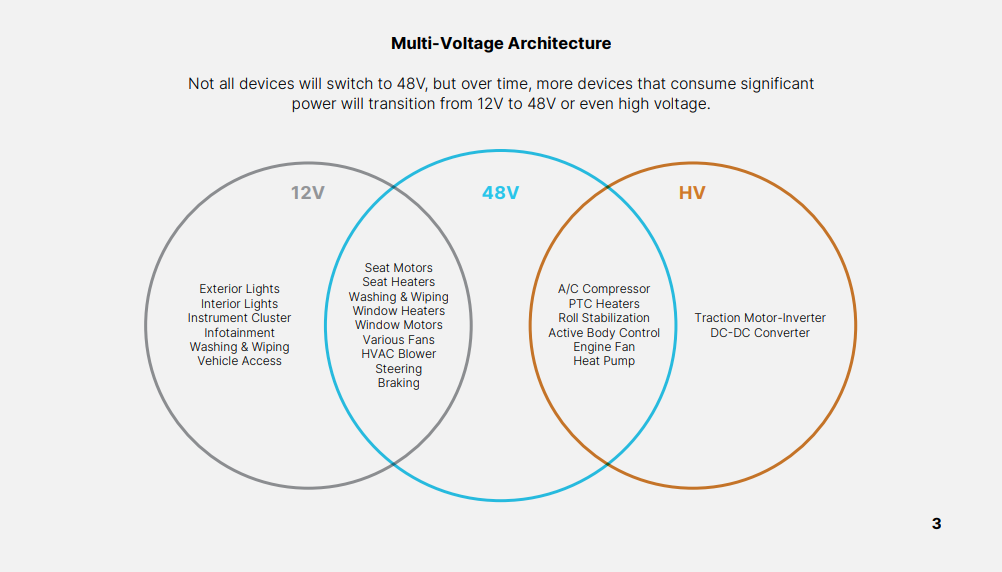
It is also worth noting that not all devices will switch from 12V to 48V. Some smaller devices that consume less power will stay at 12V. In addition, as the market transitions to BEVs, some devices will run at the battery pack voltage instead, often at 400V or 800V.
In those instances where 48V makes sense, designers will have to take several steps to ensure the safety and reliability of the systems.
Sealing requirements
If a 48V connector is accidentally exposed to an electrolyte like salt water, the resulting electrochemical corrosion reaction more aggressively attacks the terminals than it would at 12V, so designers should keep that in mind when deciding whether a connector must be sealed. Wherever sealing is indicated, be sure to use proven, robust sealing technologies.
Arcing prevention
Arcing is a risk that is related to voltage level and separation between terminals. The temperature of an electrical arc is between 2,800° C and 19,000° C. When a 12V circuit is broken, small arcs can occur, but they typically self-extinguish quickly. At 48V, arcs have the potential to last longer and result in catastrophic damage to the terminals and connector. To prevent this, terminals should be spaced properly in connectors, and special care should be taken to avoid hot disconnects.
Avoid terminals with a history of intermittent contacts, fretting corrosion or terminal push-outs (TPOs). If a terminal contact is unstable, micro-arcing can destroy plating or compromise the terminal base metal, leading to high resistance or a welded connection.
Utilize effective terminal secondary locking to ensure that terminals are fully locked in connectors. TPOs can result in slow or intermittent power disconnects, which can cause destructive arcing.
Before servicing a 48V connector, the 48V power supply should be disconnected. Slowly un-mating an energized connection system can result in a prolonged arc with thermal consequences.
Separation of voltages
Special precautions must be taken in a mixed-voltage system to ensure that current cannot flow from a 48V device to a 12V device. Isolating circuits running at different voltages is the best solution.
The conservative approach is to avoid connectors that have both 48V and 12V circuits. If that is not possible, connectors should be partitioned to physically separate the voltages. When routing a wiring harness, the separation of 48V and 12V circuits is preferred but not always possible.
Avoid routing 48V leads in areas where the wire insulation could be damaged, and apply coverings where necessary. Compromised wire insulation can lead to arcing against grounded metal in the vehicle. In addition, avoid using the same ground studs for different voltage devices. If the ground stud becomes loose or detached, current could flow from a 48V device to a 12V device through the shared connection.
Creepage and clearance considerations
Whether qualifying existing connectors or designing new connectors for 48V systems, use the IEC 60664-1 Edition 3.0 (2020-5) specification to determine the proper creepage and clearance to meet requirements for terminal position in connectors. Creepage is the shortest distance between two conducting points along the surface of an insulating material. Clearance is the “line of sight,” or shortest distance through the air between conductors. When applying the specification, it is important to protect for 60V, the upper limit of the overvoltage range.
Use the appropriate pollution degree for sealed and unsealed connectors (usually level 2 or 3) and select the correct material group based on the Comparative Tracking Index (CTI) as defined in IEC 60112/UL 1950. The CTI is the maximum voltage at which a material can withstand 50 drops of contaminated water without forming conductive paths due to electrical stress, humidity and contamination. Most automotive connectors and headers with traditional terminal spacing will meet clearance requirements, but some will require subtle design changes to meet creepage requirements.
THE RISE OF 48V
Electrical architectures based on 48V provide many benefits, but design guidelines must be carefully followed to mitigate any risks associated with the higher voltage.
As 48V devices become more common in modern, mixed-voltage vehicle architectures, advanced technologies can help ensure that the architecture can support them. For example, wiring harness automation can significantly reduce the risk of terminal push-outs. Advanced software algorithms in 48V solid-state electrical centers might be able to detect and mitigate arcing. Defining the power net architecture across various vehicle types will help establish 48V supplies and backups that meet all functional safety requirements. And designs in printed circuit boards and other elements can enable power distribution modules that are smaller, cooler and less expensive at 48V.
Versigent is at the forefront of 48V development. Through our broad portfolio and extensive expertise, Versigent is helping to ensure the safety and reliability of systems that will play a key role in the electrified future of mobility.
COLOR CODING FOR 48V
In the automotive industry, orange connectors and wiring are synonymous with high voltage, which includes any level above 60V. This color-coding system clearly identifies which components should not be touched without proper safety training and personal protective equipment.
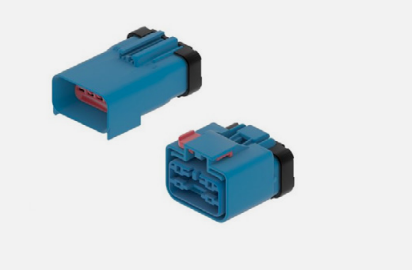
Although 48V is not considered high voltage, the increased risk of phenomena like arcing is driving calls for color coding in 48V connectors, with light blue being the leading choice.
The roots of this recommendation can be traced back to forklifts. For years, electric forklifts have relied on batteries with differing voltages, so color guidelines for battery connectors were established to avoid using the wrong battery. Today, the blue connector standard for 48V connections has been adopted by many industries and will most likely be used for 48V automotive connectors and wiring.

Working With Versigent
Our customers get a partner that deeply understands their design and execution needs.
Careers
Our strength is our people, driven by a passion for quality, reliability and engineering excellence.
View Related Jobs