
-
 Technology Portfolio
Versigent draws on the most innovative and optimized technologies to create a full range of advanced power, signal and data distribution systems.
Technology Portfolio
Versigent draws on the most innovative and optimized technologies to create a full range of advanced power, signal and data distribution systems. -
Signal & Data
Signal and data network technologies connect key systems, handling everything from simple control signals to large data flows.
-
Power
Regardless of powertrain, today’s vehicles rely on extensive power distribution capabilities to function.
-
Working With Us
With Versigent, our customers get a partner that deeply understands their design and execution needs.
-
Design
Versigent has the boldness, creativity and versatility to design innovative and unexpected solutions for your most complex requirements
-
Execution
Versigent excels at manufacturing efficiency, automation and execution. It’s an integral part of everything we do.
-
About
Versigent is a global leader in intelligent electrical architectures, delivering solutions at speed with a legacy of innovation and expertise.
-
Senior Leadership
Versigent’s senior leadership team brings deep industry expertise and a focus on innovation to drive solutions at speed.
-
Investors
Visit Versigent’s Investor Relations Site.
-
Sustainability
We deliver solutions of the highest quality and reliability – designed, developed and manufactured responsibly – that transform society.
-
Technology Portfolio
Versigent draws on the most innovative and optimized technologies to create a full range of advanced power, signal and data distribution systems.
-
Signal & Data
Signal and data network technologies connect key systems, handling everything from simple control signals to large data flows.
-
Power
Regardless of powertrain, today’s vehicles rely on extensive power distribution capabilities to function.
-
Working With Us
With Versigent, our customers get a partner that deeply understands their design and execution needs.
-
Design
Versigent has the boldness, creativity and versatility to design innovative and unexpected solutions for your most complex requirements
-
Execution
Versigent excels at manufacturing efficiency, automation and execution. It’s an integral part of everything we do.
-
About
Versigent is a global leader in intelligent electrical architectures, delivering solutions at speed with a legacy of innovation and expertise.
-
Senior Leadership
Versigent’s senior leadership team brings deep industry expertise and a focus on innovation to drive solutions at speed.
-
Investors
Visit Versigent’s Investor Relations Site.
-
Sustainability
We deliver solutions of the highest quality and reliability – designed, developed and manufactured responsibly – that transform society.
Today’s vehicles can sense the world around them and take actions based on what they perceive. They can deliver safety, comfort, convenience, and communication to drivers and passengers in ways that have never been done before. And every year they get better at it.
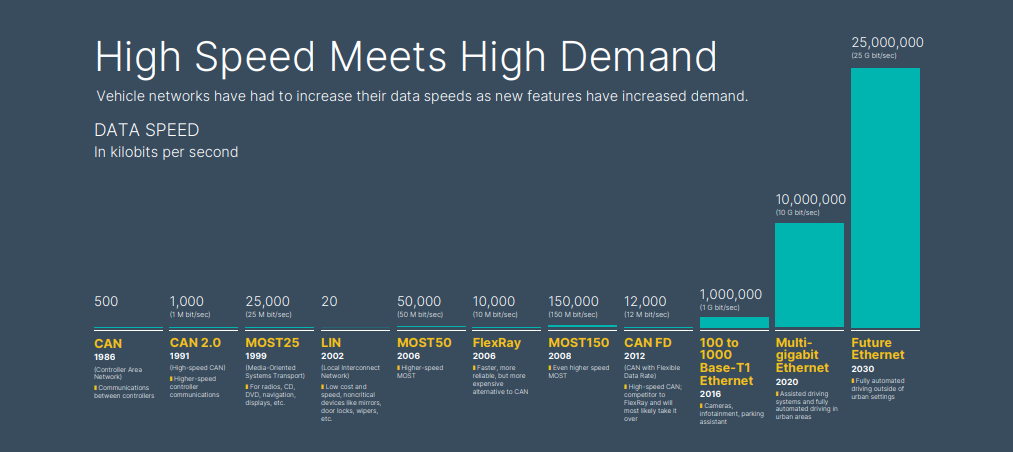
But vehicles cannot do any of that without the right data connectivity, the vehicle’s “nervous system” linking the various sensors and actuators throughout the vehicle to the “brain” of the vehicle’s compute platforms. As the sensors and compute become more sophisticated and vehicles become more software defined, bandwidth requirements for those data connections are rapidly increasing beyond the capabilities of traditional automotive networks.
The industry has seen explosions of data before — in data centers, in offices and in homes — and can leverage lessons learned over decades for the relatively new challenge of defining data networks for automotive applications. But vehicles have unique needs, and accounting for those needs in the safest and most cost-effective way will lay the groundwork for even greater innovation.
A NEW KIND OF NETWORKING
Vehicle network architectures are facing unprecedented pressures. Traditional point-to-point analog connections are giving way to digital approaches. High-resolution radars and cameras are creating high-bandwidth streams. Electronic control units (ECUs) are starting to feed large amounts of data to each other within the vehicle. These trends will only accelerate as softwaredefined vehicles take shape.
To accommodate these emerging requirements, data connectivity technologies will have to contend with challenges specific to the automotive world:
• Electromagnetic interference (EMI). The limited physical space available in the body of a vehicle increases the possibility of EMI. With so many electrical and electronic components in close proximity to one another, data networks must be designed both to resist the electromagnetic “noise” that could potentially be thrown off by other components and to refrain from emitting noise themselves.
• Latency sensitivity. If there is a lag in the data coming from one of the sensors, it may be more difficult to fuse the data with that of other sensors to get a real-time picture of the environment around the vehicle, affecting decision making at higher levels of automation.
• Fail-safe requirements. Highly automated vehicles must be able to recover from failures in a controlled way. A data network solution should be capable of rerouting around failures to ensure that the vehicle continues to operate safely until it comes to a stop.
• Weight. Every gram of weight that can be removed from a vehicle makes it more efficient and potentially reduces cost. Plus, wiring that occupies less space frees up room for other components that could enable additional features.
Several data connectivity networking technologies have risen to the fore to address these needs in ways their predecessors cannot.
Automotive Ethernet
Ethernet has a long and extremely successful history in IT. Invented in 1973 and standardized by the Institute of Electrical and Electronics Engineers (IEEE) in 1985, Ethernet came to dominate local area networks used in business, fending off all competing technologies, such as Token Ring. Ethernet has proven to be a versatile and resilient standard to fuel advances in communications over decades. Versions of Ethernet run over coaxial cable, fiber optics, and unshielded twisted-pair wiring, and speeds have increased from 10M bit/sec to more than 100G bit/sec. Ethernet is well understood and refined after decades of use.
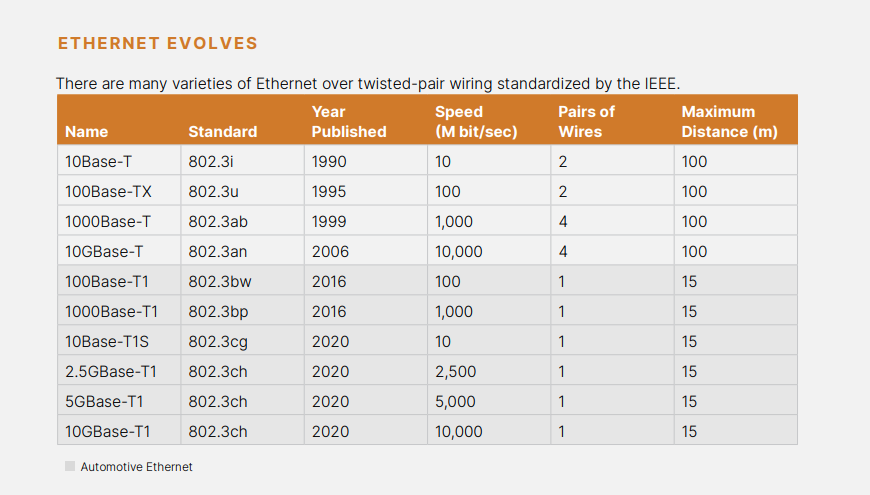
As automotive networks began to connect more computing resources in vehicles, it was only natural to turn to Ethernet, and in 2016 the IEEE published the first Automotive Ethernet standard, IEEE 802.3bw or 100Base-T1. While the bandwidth of 100M bit/sec is comparable to the 100Base-TX introduced in 1995, there are key differences in the automotive version.
Both standards run on unshielded twisted-pair wiring, where two copper wires are twisted together along the length of the cable. This has the effect of producing less electromagnetic radiation and cross-talk that could interfere with other wires or components, while also resisting interference from other sources.
However, 100Base-TX uses two wire pairs, while Automotive Ethernet uses a single pair, immediately reducing weight and cost. The pair is “balanced,” meaning the signals have equal but opposite voltages. Transmit and receive signals are both conducted on the single pair, instead of on the separate pairs of 100Base-TX.
The 100Base-TX standard was also specified for a maximum length of 100 meters, a length that subsequent Ethernet standards have adhered to. Automotive Ethernet was specified for a maximum of just 15 meters. Obviously, automotive applications don’t need the longer distance to network components within a vehicle, and the shorter length allows for lighter cabling.
Another key difference is the encoding done by the transceivers at each end of the cable. The 100Base-TX standard uses the Multi-Level Transmit (MLT-3) technique that cycles through three voltage levels to encode bits on the wire, while Automotive Ethernet uses three levels of pulse amplitude modulation (PAM-3) to encode bits through the amplitude of signal pulses, allowing more bits to be encoded with each wave. Combined with other encoding techniques, the resulting frequency is reduced from 125 MHz to 66.6 MHz, which again helps protect against EMI and cross-talk.
Next steps in Automotive Ethernet
The 100M bit/sec of the IEEE 802.3bw standard can cover many initial automotive applications, so it is widely used today. But as we look ahead to higher-definition video streams and aggregation of data from multiple sensors onto common cables, higher speeds will be necessary.
Soon after IEEE 802.3bw was finalized, the IEEE ratified 802.3bp, or 1000Base-T1, allowing for gigabit speeds over shielded or unshielded twisted-pair wiring. This standard shares many attributes with its predecessor, but the frequency is nearly 10 times as high, at 600 MHz. This means that the cables are more vulnerable to cross-talk, and engineers have to keep this in mind when they design systems, as they manage electromagnetic noise throughout the vehicle, testing rigorously and shielding where needed. This standard will provide enough bandwidth for the next two or three platform generations.
In 2020, the IEEE produced 802.3ch, which provides for multigigabit Ethernet at standard rates of 2.5G bit/sec, 5G bit/sec and 10G bit/sec over the same 15 meters. Shielded twisted pair wires will operate at these speeds, but electrical frequencies in excess of 7 GHz may require the use of shielded parallel pair wires to minimize EMI issues.
A key benefit of Ethernet is that it is a flexible network, allowing easy reconfigurations. If there is a failure, an Ethernet router can route data traffic a different way. This is important to ensure uninterrupted connectivity for major compute components in a vehicle.
Also critical in vehicle networks is copper-based Ethernet’s ability to carry electrical power along with the data signal, a feature called Power over Data Lines (PoDL). PoDL can support up to 500 mA of power, enough for certain sensors, such as an optimized satellite camera. This allows vehicle manufacturers to run a single pair of wires to some sensors for all of their needs, reducing weight and simplifying the architecture.
Automotive coaxial applications
Coaxial cable (“coax”) has long been used for data networking. Consisting of an insulated wire in the center surrounded by a shield of conductive material, coax was the original cable used for Ethernet and is still widely used for cable television hookups. Different types of coaxial cable have varying levels of performance, and automotive applications use specific cables based on application parameters.
Its ruggedness and resistance to interference have made coax popular in automotive applications, and the global interface standard for these connections, known as FAKRA (Fachkreis Automobil), has been used by most automotive OEMs for more than 20 years.
The connectors operate very well at frequencies up to 3 GHz and can be adapted for 6 GHz applications through specific design features at the terminal, allowing speeds of up to 8G bit/sec.
Recent automotive coaxial cable applications include digital camera systems in vehicles. The high bandwidth capabilities of coax cable allow for video signal and camera power transmissions over a single cable.
As applications have grown from simple backup cameras to complex surround vision systems, the size of the FAKRA interface has become cumbersome. A new generation of smaller coax connectors is being developed to address vehicle packaging issues.
These “mini-coax” connectors are significantly smaller than today’s automotive interfaces, allowing for increased density in device package sizes.
Another feature of the mini-coax systems is that they support significantly higher bandwidth than current automotive products. While FAKRA can support frequencies up to 6 GHz, mini-coax supports applications at 9 GHz to 15 GHz, meaning bandwidth of 20G bit/sec and more.
Future automotive computing systems will include a significant amount of coaxial cable to transfer data between more complex onboard computing platforms.
PCI Express
Another technology under consideration for limited automotive applications is Peripheral Component Interconnect (PCI) Express. Created in 2003, PCI Express is a bus interface used mainly to connect peripherals to computer motherboards. The most recent version of PCI Express supports up to 128G bytes/sec.
The maximum distance for PCI Express is extremely short — only half a meter — but it does not require a transceiver, which can save on costs.
For ECUs that are close to each other in the vehicle, PCI Express can be an ideal solution.
Other network technologies
Fiber optics may seem like a good choice for automotive applications, but they have drawbacks that will likely impede widespread adoption. Fiber-optic lines use pulses of light to transmit data over glass or plastic fibers, which means they do not generate electromagnetic radiation, and they are not susceptible to interference from other sources. However, there is no way to deliver power over a fiber-optic data line, which means that components would require separate power. Fiber optics tend to be more expensive, requiring a transceiver to translate electrical signals into light pulses. The manufacturing process is also expensive. And perhaps most importantly, fiber-optic lines have a limited bend radius, so weaving fiber-optic lines through the narrow confines of a vehicle without bending them too much can be challenging.
Another technology that has been considered is multicore, where a cable has a large number of single leads. The most prominent example is USB Type-C, which has taken hold in the PC world, combining power and data on the same cable. However, USB-C cables are limited to a few meters and are expensive to make. They also limit bandwidth to 5G bit/sec per channel and require a transceiver to divide data into those channels, which creates additional cost.
As Automotive Ethernet and other data connectivity options ramp up, older technologies that have been used in vehicles for years are likely to continue to be used for simple applications where low data rates are sufficient. One example is Local Interconnect Network (LIN), which requires an inexpensive chipset and connectors. Other relatively inexpensive examples include Controller Area Network (CAN), which operates at up to 1M bit/sec; and CAN Flexible Data Rate (CAN-FD), which runs at 2M bit/sec. FlexRay supports up to 10M bit/sec and remains in use for safety-critical applications, but it is more expensive and expected to be phased out over time. A low-speed Automotive Ethernet option, 10Base-T1S, was recently completed to address these applications.
While most of these network technologies are symmetric, some in-vehicle applications are asymmetric – only requiring high bandwidth in one direction – such as cameras or highresolution displays. Widely used asymmetric technologies include Flat Panel Display Link (FPDLink), Automotive pixel link (APIX) and Gigabit Multimedia Serial Link (GMSL).
HDBaseT Automotive is an asymmetric technology that is gaining momentum for its ability to tunnel up to 4G bit/sec of Ethernet with very low latency over 15 meters of standard, jacketed, unshielded twisted pair wiring, and up to 8G bit/sec over shielded twisted pair wiring. Because HDBaseT, like Ethernet, uses pulse amplitude modulation, the physical layer is less complex than that of other technologies, keeping weight and cost down. Next-generation architectures require that solutions provide a robust foundation for all of the components that make active safety possible, while at the same time reducing vehicle weight and enabling innovation to thrive. Automotive Ethernet, mini-coaxial cable and PCI Express present some of the most promising opportunities to build vehicles that meet those standards.

Working With Versigent
Our customers get a partner that deeply understands their design and execution needs.
Careers
Our strength is our people, driven by a passion for quality, reliability and engineering excellence.
View Related Jobs